


Reflection in 2-D
When you look out over a beach or lake, on a not-too breezy day, you will notice that the crests of the waves appear in a line. This line is referred to as a wavefront – a term that can also apply to longitudinal waves. Wavefronts make it easier to understand wave reflection in two dimensions. The direction of a wavefront can be shown by an arrow perpendicular to the wavefront.
Reflection at plane surface
Just as light waves obey the rule of reflection (the angle of incidence equals the angle of reflection) so too do mechanical waves. The angle of the waves with respect to the boundary of two media is easily defined by the angle of the wavefront to the boundary. Knowing this angle enables you to predict the direction of the wavefronts upon reflection.
If you need some further help in understanding this rule view the video below.
View the reflecting water waves video.

Reflections at a curved surface
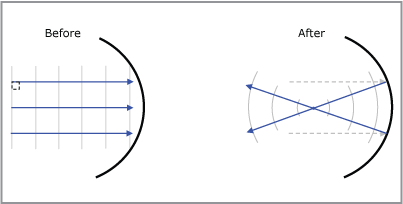
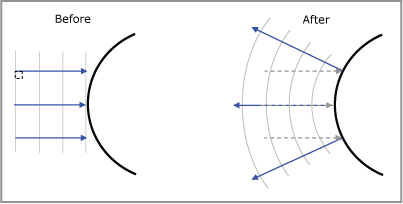
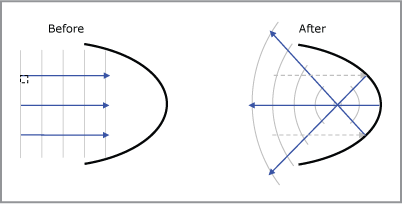
A curved surface can be imagined to be an infinite series of angled plane surfaces. This means the law of reflection can be applied to each section of an incident wavefront. Let us consider two common, curved surfaces.
Here are some wavefronts approaching a concave surface.
Here are some wavefronts approaching a convex surface.
Here are some wavefronts approaching a parabolic surface.
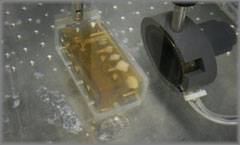

A medical application of 2-D wave reflection is found in an experimental process known as HIFU (High Intensity Focused Ultrasound). In this non-intrusive technique, an ultrasound transmitter located outside of a patient's body focuses reflected ultrasound waves of large amplitude into a patient's body.
Photo courtesy of the Clinical HIFU Unit, Churchill Hospital, Oxford.
The transmitted wave energy is focused within a small region approximately 0.50 cm wide, absorbed by body tissue and transformed into heat. The heat is used to destroy dangerous cells. The above image shows the penetration and extent of the affected regions (white shapes) due to the ultrasound waves on some orange stained gel.
The image below shows two MRI cross-sections of a patient's torso. The left image reveals a large tumour on the left kidney (circled). The image to the right shows the effect on the tumour after treatment (circled).
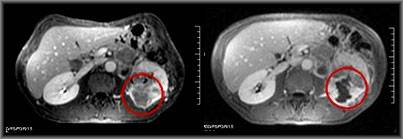
Photo courtesy of the Clinical HIFU Unit, Churchill Hospital, Oxford.
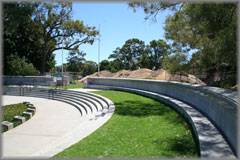

Kings Park in Perth is a favourite destination for tourists. Apart from the views, botanic gardens and eateries there is the State War Memorial. An interesting feature of the memorial is the whispering wall shown on the right. If you whisper at one end of the semi-circular wall, someone at the opposite end can hear you because of the multiple reflections of sound waves bouncing off the wall.

1 |
How much wave energy is reflected at a low impedance boundary as a proportion of the incident energy? |
2 |
What happens to a transverse wave at a high impedance boundary? |
3 |
If a longitudinal wavefront approaches an impedance boundary at an angle of 30° to the boundary, what is the angle of the reflected wavefront relative to the boundary? |


